Callbacks Are Costing You More Than You Think: How to Handle Redos Without Losing Money
Every service business has callbacks. Most owners absorb the cost without ever measuring it. Here is how to track redos, decide who pays, and reward the crews who fix them.
A callback is a return visit to fix or redo work that was already done and paid for; this post covers how to record callbacks, decide who pays for them and give credit to the crew that fixes them.
Every service business has callbacks. A customer calls because a shrub was missed, a bed wasn't edged, a gate was left open, or the job just wasn't finished the way it should have been. Someone has to go back. And almost nobody counts what that trip really costs.
For a long time I treated callbacks as part of doing business. A crew would go back, fix it, and I'd move on. What I wasn't doing was asking a simple question: who paid for that return trip? Usually the answer was me, and I never saw it show up anywhere.
What does a callback actually cost?
A callback is never just the time on the property. It's the labor for the return trip, the fuel and truck time to get there, and the job that crew didn't do while they were fixing something they'd already been paid for. It also disrupts the schedule for the rest of the day, and it quietly teaches the original crew that finishing it right the first time doesn't change anything.
That last part is the real problem. If the crew that caused the callback pays nothing and the crew that fixes it gets nothing extra, the system rewards sloppy work and punishes whoever gets sent to clean it up.
Step 1: Start Recording Every Callback
You can't manage what you don't record. For each callback, write down the date, the property, which crew did the original work, which crew fixed it, and how many hours the fix took. Even a notebook or a shared spreadsheet works. The goal is to be able to answer two questions at the end of every week: how many callbacks did we have, and how many hours did they eat?
Once you track it, you'll probably find the pattern is smaller and more specific than you expected. A callback problem is often one crew, one type of job, or one habit that keeps repeating.
Who should pay for a callback?
There are really only three ways to handle the cost of a callback:
- The company absorbs it. Simple, but it hides the cost and gives crews no reason to improve.
- The crew absorbs it on their own time. This pushes the cost to the right place, but it can feel punishing and leave crews resentful or unwilling to report their own mistakes.
- The cost is tied to the crew's pay. The hours the callback consumed are accounted for against the crew responsible, so the cost lands where it was created, openly and consistently.
The third approach is the one I settled on, because it's the fairest and the most transparent. Crews see exactly what a callback cost and why, instead of finding out later that something was deducted.
How do you give credit to the crew that fixes a callback?
This is the part most owners skip. When one crew goes back to fix another crew's work, they're doing extra work that wasn't on their schedule. If you charge the original crew but give the fixing crew nothing, you've created a job nobody wants.
The better approach is to credit the crew that does the fix for the hours they spend on it. That way, being sent to correct someone else's callback doesn't cost them anything, and the whole company has a reason to get the work completed for the customer quickly.
How does this work in Easy P4P?
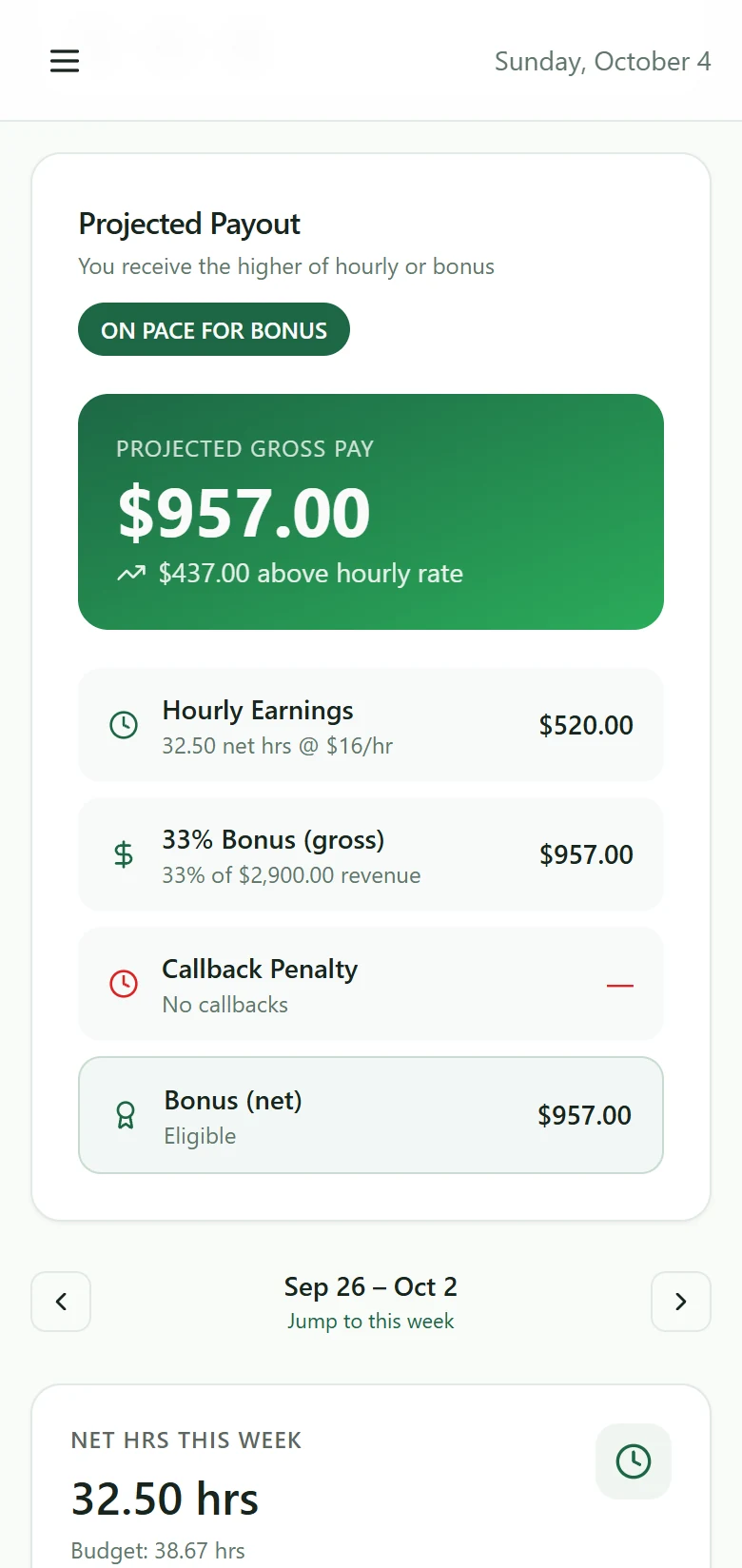
I built this into Easy P4P because I wanted the math to happen automatically. When a callback is logged, the hours are charged against the crew responsible, either at their hourly rate or at the fixing crew's rate. The crew that fixes another crew's callback receives a Callback Fix Credit for those hours. Both show up as separate lines on the payout breakdown, so everyone can see exactly what happened and why, without a spreadsheet and without an awkward conversation.
Keep It Fair and Keep It Visible
A few rules make a callback policy work in practice:
- Define a callback clearly. Make sure crews know what counts, so there are no surprises.
- Be consistent. The same rule should apply to every crew every time.
- Show the numbers. Crews accept a charge they can see and understand far more readily than one that appears on a paycheck with no explanation.
- Look at the trend. A rising callback count is an early warning about training, scheduling, or job quality, and it's worth acting on before customers notice.
The Bottom Line
Callbacks aren't going away, but they don't have to quietly drain the business. Record them, put the cost where it belongs, and reward the crews who fix them. Do that consistently and callbacks become a number you manage instead of a leak you never see.
If you'd like the tracking and the pay math handled for you, Easy P4P calculates callback penalties and fix credits automatically and shows every line on the crew payout breakdown.
More from the founder's journal
- The 8 KPIs Every Service Business Owner Should Check Weekly
- How to Connect Yardbook to Easy P4P with Zapier (Step-by-Step)
- Know Your Numbers Every Day: How Easy P4P Keeps Your Crews and Business in the Green Zone
- The Tech Stack I Use to Run My High-Six-Figure Operation
Use Yardbook? See how Easy P4P works with it. Want to know who writes this? About Jason and QuickCall.